
Watch Your Step! The Interesting Way Your Mind is Hindering You As a Mom

Let’s start this conversation with a cliché: They say the day a baby is born so is a mother.

And here’s another one: Nothing quite really prepares us for motherhood (this one is quite an understatement).

From the onset of pregnancy, right down to the birthing experience, our child’s unique personality and even the circumstances surrounding our motherhood journey at any given moment, it’s hard to predict what will come up as we walk around with our mom’s hat on.

It might even be a case of we don’t know what we don’t know. Our unique motherhood journey unveils itself gradually with each milestone, stage and phase that we arrive to. You could even say that being a mother is such a dynamic role because we constantly have to be adapting and piecing together all the layers and variables that come our way in real time. It’s impossible for anyone to fully prepare ahead of time as all the possible combinations are too many to predict.

Simply put, there’s a myriad of cognitive and emotional demands placed on us given all the learning that takes place while we parent.

Yet, one thing I’ve seen play out countless of times as a Certified RTT Practitioner is how at some point during our motherhood journey, The Pebble in The Shoe Theory begins to unfold. And how it starts to undermine our confidence as mothers.

For the most part, we think our life journey is a linear one: going from being infants, to children to teenagers and then to full-grown adults. And that our role as mothers also follows a linear path (baby arrives and we begin to acquire practice and knowledge about what to do next). It seems that our past experiences have given us a better vantage point from which to effectively parent.

But it is not usually the case.

And the most tell-tale sign of this is when we enter what I call the triggering zone.

We enter the triggering zone whenever it seems that our kids have found the exact buttons to push that get us into reactive mode. It’s almost like we don’t recognize ourselves. Only after we’ve had time to mull it over, and mom guilt finally creeps in, we realize with embarrassment that we probably took things out of proportion and there was no need to react like Mommy Volcano.

But in the heat of the moment, it appears we’re simply going on auto-pilot, reacting the same way again and again, even when we have tried to change our reaction or even negotiating with ourselves that no matter what, we won’t go off like last time. (Only to repeat the cycle the next day).

Why is it that our kids push our buttons like no one else?

And why does it feel we’re constantly in this loop: feeling overwhelmed and frustrated to the point of snapping and over-reacting, then feeling guilty about it afterwards and trying to change our ways but falling into the same pattern repeatedly?

Cue in The Pebble in The Shoe Theory.

The triggering happens because we’re re-enacting a relationship that shaped who we are now as adults.

Yes, that’s right. We’ve been in a parenting relationship before, except that previously, we were the child. What’s more, most of our internal beliefs came from this dynamic.

The blueprints we internalized as children while we were being parented by our parents are pretty much still in place when we reach adulthood. If we haven’t actively been doing the inner work on ourselves prior to becoming mothers and ‘peeling away the layers’ as they call it, we will tend to carry with us all these old beliefs and blueprints around like an old suitcase, and which are at play when we parent.

It is part of our human experience to form beliefs about ourselves and the world around us to make sense of things. Through our childhood and even still to this day, we continue to have millions of beliefs, some ranging from the inconsequential (“X brand is the best brand for paper towels”) all the way to what we subconsciously believe about ourselves or our abilities (“I’m not really good at math”) and everything in between.

Internal beliefs underpin every single action we take or not take, without exception. There is never a situation where a belief isn’t at play. And this is mostly highlighted in our role as mothers. Sadly, many of those beliefs tend to be outdated and limiting. But because they operate subconsciously, we’re not usually aware.

What The Pebble in The Shoe Theory is about is that our children tend to be our biggest triggers because when we interact with them we re-enter a relationship we’ve been in before and so we’re playing out (now as mothers) a part that we were subconsciously witness to: that of our own parents’ behaviors and attitudes when they parented us.

The caveat is that we’ve only played this interaction from the child side in the past and now we’re mirroring this dynamic from an outdated blueprint.

Our children’s behavior in fact has nothing to do with our triggers. They are going through their own developmental stages and acting age appropriate as they go through their own growing curve (barring any medically diagnosed conditions).

What our children do is act as a mirror that projects back at us our own beliefs and conditionings that formed during childhood. But because it’s a mirror image, everything is reversed. And we are unable to see how the distortion is playing out in real time. Or in this case, how we’re approaching our parenting through a lens that is outdated, limiting and in most instances, no longer valid.

To show The Pebble in The Shoe Theory at work, let’s look at this flipped image of singer Adele below.

Twitter/TurnYourPhone

The image is a seemingly mirrored version of the original, used as the cover art for her album “25.” However, if you look at the image right side up (or by turning over your phone) you’ll see something much more disturbing.

While Adele’s face has been turned upside down, her eyes and mouth have actually been left the right way up. As a result, when we turn the picture right side up, the singer’s face looks outright nightmarish.

This is known as the Thatcher Illusion, and it illustrates how our brain can’t properly process a face (or a photo of a face) that is upside down. The interesting part is that the brain thinks it can, so you get a confident feeling that everything is alright, until you turn it over.  

So how does this link to The Pebble in The Shoe Theory?

In a nutshell, it illustrates how what we think might be triggering us is actually an upside-down version of old beliefs we have internalized that are distorted (but from where we stand they seem quite ‘normal’) or we simply don’t notice it (they are blind spots).

We think we parent from a cause-effect logical standpoint: Our child acts and we react to it. Or more specifically, our child acts and that behavior triggers us. Just like how we think Adele’s upside-down face image looks okay.

But when we flip it the other way around, we realize the features are not what they should. Likewise, when we start to recognize our triggers as blind spots that signal old limiting beliefs at play, and how we might be re-enacting those early-year relationships we had with our caregivers and parents, we then start to see how outdated and limiting they truly are. 

Becoming aware of this is the first step towards changing how we parent to avoid falling victims to these triggers and perpetuating the cycle with our kids. Therefore, we can start healing ourselves from limiting and self-sabotaging beliefs that are holding us back.

When we’re feeling overwhelmed, frustrated, and triggered we think we need to address the feeling directly.

But the overwhelm and frustration are only the symptoms. They’re not the issue.

It may seem you feel overwhelmed and triggered because your child just had tantrum number thirty of the day, or she is not cooperating the way she should, or the constant whining is driving you crazy.

In fact, it may also seem that all of the million to-do’s, the endless chores at home, what might be happening in your business (or at work), issues with your spouse or partner, your finances, or just simply trying to juggle all the balls in the air are the reason why you’re feeling triggered.

But this is not why you react with overwhelm and frustration.

All of the above- including your children- are external things. They are happening OUTSIDE of you.

The root cause of your overwhelm and frustration lies in your thoughts.

What you actually think about the circumstances in your life. These are your internal beliefs: the ones that were wired in when you entered this parenting relationship the first time around. Back then you were the child in the relationship. And you internalized things from a child’s point of view.

These beliefs created a blueprint that conditioned your mind into using it as reference moving forward. Now, as you find yourself on the other (parent) side of this parenting relationship some decades later, your mind is looking at the relationship the same way you look at Adele’s upside-down picture. It seems familiar and for the most part, normal. But we know it could very well be distorted. And our triggers point to where those old limiting beliefs are hidden because they are causing overwhelm and frustration.

Depending on your own personal set of circumstances and upbringing, the blueprints that you formed in your mind early on, can either be working for you or against you.

The constant triggers point towards a misaligned blueprint. 

We think we’re able to tackle motherhood from a clean slate and armed with all the knowledge we accumulate from books, workshops, classes or even from others that have gone before us as we first become moms. But we have certainly experienced the parenting relationship before.

The so-called pebble in the shoe refers to all those limiting beliefs we’re carrying around unaware of their existence and how they might be impacting the way we’re showing up as mothers.

The reality is that everyone’s beliefs-which are almost always invisible and unconscious- shape every single thought and action we take in every area of our lives.

Beliefs are like the Thatcher Illusion. It’s only when you turn them on their head that you can begin to see the truth even though what you “see” looks “normal” yet, in reality, it is often highly dysfunctional and contradictory.

Our inner beliefs, like our mind, arise out of our biology, but are influenced by so much more than cells and signals: Our emotions, memories, relationships, also play a part albeit unconsciously in how these beliefs are shaped.

To break this cycle of triggers and negative thoughts, you need to be aware of the limiting beliefs that make you feel overwhelmed, stressed, angry, frustrated…and start to choose to act on a different blueprint altogether.

If you understand the importance of upgrading old limiting beliefs and rewiring your mind (with a powerful new blueprint) I invite you to take the first step into having a Rapid Transformational Experienceso you can leave overwhelm and frustration behind, and instead install powerful new beliefs that will make you feel inspired, calm and confident as a mom. Frazzled mom is so last year! Step into your motherhood shoes empowered and with ease knowing there’s no painful pebbles keeping you triggered.

Schedule your free Connection Session with me. We’ll talk about all the things that are limiting you.

As a Certified RTT® Practitioner, I’ll share what you can do right now to start taking Inspired Action and feel calmer, confident and guilt-free. Even if we don’t work together, you’ll leave the session knowing the exact steps to break the cycle of limiting beliefs so you can move forward with confidence and ease.

Book your session here:

https://calendly.com/themomergymovement/30min

How to Mix Boredom and Kids the Smart Way to Enjoy More Energy

Know how to swap your bundle of ‘bored’ for a bundle of joy using these powerful tips.

Nothing depletes a mom’s energy faster than a bored child. Hearing the words “I’m bored” seems to grate us down to our core, especially while glancing around and noticing all the toys and games your little one has at her disposal. You also wonder why Santa even bothers (especially knowing full well all the hassle and stress Santa went through to make Christmas magical.)

On the other hand, you have a million things to do and cannot be your child’s personal entertainer the whole day. And you shouldn’t! 

So how do we effectively deal with the whole boredom conundrum?

Loving our children means many things, but martyrdom is not one of them, and just because they’re bored, it doesn’t mean you should be the one to suffer. So let’s start off by really smashing the belief that boredom in our children is a problem.

No, it isn’t. Boredom IS good for kids!

This requires a mindset shift. But once you adopt it, guilt and stress will go out the window. 

Boredom is not a problem to be fixed

Just with this one alone, your energy levels should go back up a couple of notches. 

Let’s face it. Most times, we’re firing on all cylinders while precariously carrying around a truckload full of plates, platters, and Tupperware containers with mismatching lids that we can’t seem to put down. In other words, we’re constantly busy solving our family’s problems. It looks you’re on permanent office hours handling everyone’s affairs. Whether it’s solving for the eternal question of “What’s for dinner?” to helping your spouse find the whatchamacallit that he can’t find, to looking for a lost sock or toy.

So please don’t make boredom another problem that requires solving.

Because, when we cannot successfully “fix” the boredom, guess who shows up? That’s right. Mom guilt (another energy vampire sucking our momergy dry).

Water the plants

Metaphorically speaking. The book The Gardener and the Carpenter by Alison Gopnik is a fantastic eye-opener into how we tend to engage in constricting and stressful parenting practices. It’s really a must-read for any parent in this day and age.

Here are some quick Cliff notes: 

According to the author, the trouble with parenting is that it treats looking after children as a form of work rather than a form of love. And by treating childcare as work, parents are doomed to feel dissatisfied because it’s a relentless, thankless, messy, unpaid occupation. 

(source1)

So when you really view parenting as an act of love and ask instead, “how can I love my child better?” a whole new world of possibilities opens up.  

We fret over making the best choices for our kids all around. Therefore, there’s a lot of pressure and anxiety around everything that they do, what they eat, how they engage their time. There’s the notion that we are the ones that have to come up with all these things so that our kids turn out to be great adults and amazing human beings. 

But when you see Gopnik’s point of view, it simplifies things by making parents responsible for simply creating a set of conditions_ or fertile ground_in the gardening metaphor. But then the choices that our child makes are entirely up to them. 

For example, we can stress about planning hyper-healthy meals for the family and going crazy if you didn’t make Brussel sprouts that week because now, your kid won’t like vegetables and will now become addicted to sugar. Instead, if you just prep the foundation, make sure that what you have at home is healthy when it comes to food options, then it doesn’t matter what your child decides to eat. It’s all healthy! The choice is his, but you provide (and control) the options. This applies to all areas.  

Just by making sure that the environment is good enough for them to thrive, then, how they decide to blossom and in what the moment, it is entirely up to them. Most likely, children will thrive in a good way because parents made sure the environment was set up well. 

This book is an excellent reminder of how our children get to benefit more when we let them be and let them figure out how to play on their own, rather than being told how they need to do so. Play is their arena, their turf. If there’s anyone that knows how to play and how to do it properly, it’s children. It’s intuitive. It’s part of their DNA.

Gopnik brilliantly summarizes all this in one sentence: “We worry too much and do too much for them; children flourish when they are given freedom. When it comes to looking after kids, be a gardener, not a carpenter.”

Amen to that. 

Seriously. Get the book (and a highlighter). 

Stimulate the virtuous cycle of free play

Your child’s natural habitat is the play zone: that magical space where he gets to live out his fantasies and allows his imagination to roam free. Parents worldwide know this all too well when, after unpacking birthday gifts, children end up happily playing with the boxes, ribbons, and the foam peanuts instead of the actual toys.

That’s because children don’t need much to enjoy themselves. I’ve watched my children rip paper and create a winter wonderland with ‘snow’ while having the best time. 

And it is this unstructured time that allows children the opportunity to engage with themselves and the world – to imagine, invent, and create. 

When children are left to their own devices, they’re forced to be more creative and imaginative in finding ways to amuse themselves. So let them.

This also tends to become a virtuous cycle. Because the more that children have to engage in unstructured play, the more they use their imagination and the more creative they become. And at the same time, they start to enjoy more being left to their own devices. The more they do it, the more they have to find ways to amuse themselves, so they are forced to be more creative.

Remove the baby gate.

I get it. I’m all up for maximizing productivity every chance I’ve got. 

As adults and busy moms, we have this notion that we have to make the most out of the time we have. 

So we fall into the trap of thinking that allowing our kids to stare at their hands and draw smiley faces on their fingers is a time-waster. After all, they could be doing something better with their time: like learning a new instrument, or a new language, or something, right? We simply want to put all those extra-absorbing-and-prime-for-learning brain cells of theirs to good use.

Where I currently reside, I’m witness to this excessive structure and countless activities for young kids accounting for every single minute of their day. As in, these kids are really busy! Their school day is already long, and then, after school, they have all sorts of clubs, classes, and activities to attend.

Alison Gopnik also remarks that by keeping their timetables so packed, we’re trying to “shape (our) three-year-olds into Harvard freshmen.” There is definitely a societal pressure to want to give young children a leg up, academically speaking, so they’re able to be better prepared for the professional world.  

Yet, knowledge is not only academic; it also comes from finding new links or connections between things and making mistakes.

And free, unstructured play can provide great inventiveness and master elements of the world as they see fit. 

Boredom in this regard is fertile ground that allows children to create their own happiness and develop self-reliance while developing self-esteem, the ability to self-regulate.

Lia Karsten, a professor of Urban Geographies at the University of Amsterdam, argues that excessive extracurricular activities have transformed children from active participants to “backseat children” who are passively escorted from one structured activity to the next by their parents. 

(source 2)

I agree that having extracurricular lessons and activities is not to be avoided. They allow children to pursue things they might like and enjoy doing for a long time as a hobby or even as a profession. But the extreme IS the problem. Keeping a child in back-to-back activities the whole day until they collapse at night is not allowing their brains to be in free flow. You cannot be in free flow if everything has been structured to the tiniest detail.

The Gift of Passion

As mothers, we’re nurturers by nature. As supermom, we can come to the rescue and provide entertainment to our kids when they call out to us in despair. 

BUT when children are forced to find ways to entertain themselves, something magical happens. 

By allowing your child to connect to his own feelings, creativity, and imagination, you give them the gift of finding what they genuinely like and enjoy. A child who cannot find his own answers does not develop a true sense of self. 

There are real possible downsides to going down this route. We might end up with young adults who, in their 20s and 30s, end up having midlife crises because they don’t know what they want. 

Their parents and society always were the ones telling them what they needed to do when and how. And when they get to have the reins of their own lives and to be the ones in control, they have no clue what to do!

They haven’t tapped into their own passions or actively learned to find answers on their own. 

As adults, we know this all too well. No one can give us the answers about our own lives. We can receive guidance, mentorship, advice, examples, tricks, and hacks, but it’s up to us to decide at the end of the day.

And we usually decide based on what feels right to us_at least that’s how it should be. 

Knowing in our hearts whether we’re making the right choice or following the right path can only come when we are in tune with ourselves and our inner guidance.

This is not woo woo talk. Take a look around at all the self-help books making the NYT best-seller list that tackle this very subject. There are many adults still grappling with not knowing what they want to be or do when they grow up. And that’s okay. But allowing our kids to find and foster their unique passions and talents provides for a smoother and easier transition into adulthood, doesn’t it? 

So when you’re child says, “I’m bored,” take it as a fantastic opportunity to guide him into fine-tuning this powerful skill of learning about what he wants and what feels right. 

The Only Way Out is In

The reality is that we live in an ever-increasing digital world, with our children truly being digital natives. 

When we’re in the middle of busy and hectic times, plucking our child down with a phone or an iPad seems like a quick and easy fix to give us a much-needed breather. We tend to think that this will keep our little one’s brain engaged, but, unfortunately, it shuts down the parts that enhance creativity and imagination.

Learning how to navigate the waters of technology regarding our children is a whole subject in itself. And I am in no way opposed to technology. 

The message here is that we need to be mindful that not all technology is created equal. There’s the M&M kind of technology, and then there’s the Brussel sprout type of technology.

It’s our responsibility to be very conscious and mindful about how the technology comes into our homes and how our children make use of it. We need to assess their age and stage of development they’re in. 

Like Jonathan Fader said: “Technology is like fire. It can cook your food and can also burn down the house.”

We can’t be oblivious to the definitive downside of using technology all the time- especially when it comes to small children.

It has been well documented that apps and digital content have been scientifically devised to get non-stop engagement from us and create addiction. Even we as adults get hit with dopamine spikes throughout the day with every ping, bell, and alarm from our mobile devices.

These dopamine hits are the same as what gamblers experience in the casinos and junkies experience with drugs. 

Do we really want a constant dopamine hit to be present in our young child’s brain from so early on? 

Dr. Dimitri Christakis, director of the Center for Child Health, Behavior and Development at Seattle Children’s Research Institute, echoes this notion. He states that the cost of increased screen-time in children “will be borne by families because increased online use is associated with anxiety, depression, obesity and aggression and addiction to the medium itself.”

(source 3)

What concerns researchers is that devices are a poor substitute for activities known to be central to health, social, and physical development, including physical play and other interactions that help children learn how to confront challenging social situations.

(source 4)

Plus, both adult and young brains need downtime to allow our brains to process, file and sort the deluge of information and stimuli that we get constantly. Our brains are organs too. Just like our bodies need rest and our muscles need recovery after working out, so do our brains. 

When we don’t give our mind a chance to pause and refresh, it doesn’t work as efficiently. Likewise, our children are more likely to experience burnout and stress when constantly using devices and solely engaging with online content. 

Click here to find out how meditation can counteract the dopamine effects on young brains in as little as two minutes a day. Get started with a Meditation practice in just 7 days here.

More than one?

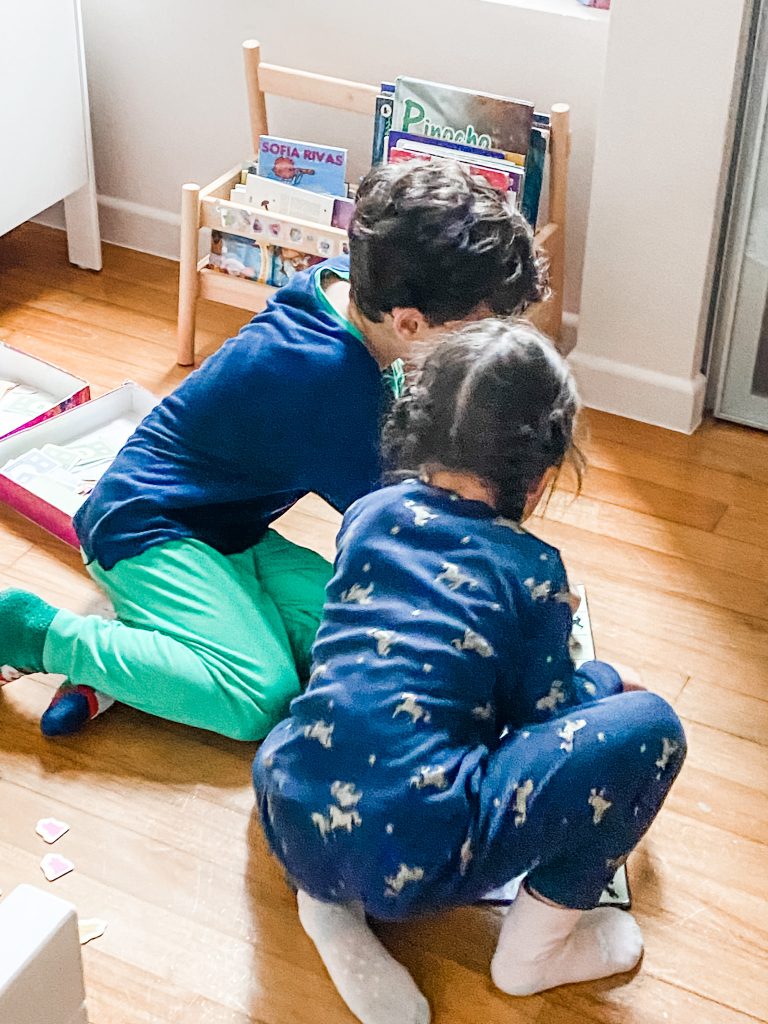
Siblings are allowed to bond more when they need to entertain themselves together. Yes, this possibly creates more friction and squabbles than sending them off to a class or course somewhere. 

With multiple kids, it definitely feels like our job becomes that of a referee: by constantly dispensing metaphorical yellow time-out cards left and right during the day.

But this is the perfect opportunity to fosters social competence, respect for rules, self-discipline, aggression control, problem-solving skills, leadership development, conflict resolution, and playing by the rules.

No one, and I mean, NO ONE, is more ruthless in making sure a child learns how to play by the rules and develop some good ol’ problem-solving skills than a sibling is.

Is it irritating having to step in to stop squabbles? Then don’t. Unless someone is in real danger or physically hurt, your children can learn to find a solution together if left to their own devices. 

It may sound overly simplistic to try and ignore fights and screaming. But just like boredom, the more we interfere, the less likely siblings are forced to find solutions collectively. Here is a great way to tune out and listen to some inspiring content while the drama unfolds. Click here. 

So the bottom line on children's boredom? The best way to help your child is to do nothing at all!

Children need to figure out how to use their free time or never learn how to manage it.

That being said, this is a disclaimer that every mom will find her own way to deal with boredom, and there is no right or wrong answer. You need to figure out what works for your child and you, mama.

As long as what works is coming from a place that gives you peace of mind and makes you feel like an empowered mom and NOT making you feel stressed, anxious, worried, and feeling like you’re coming up short on all ends.

This is about keeping your Momergy up. We try to make decisions that best benefit our little ones. But also, in making those decisions, we need to feel empowered as mothers. That’s the only way to continue showing up as the best version of ourselves in this motherhood journey.

So kudos to you, mom, for showing up each and every day. You’ve got this!

Hey mama! Wanting to know more about how to ride the guilt wave of parenting and continue this conversation with other fellow moms? Kick those feelings of burnout and exhaustion! Come and join our exclusive Facebook community!

We have a dedicated and in-depth Parenting through a Pandemic Series where we explore mom-related topics such as:

– Riding the guilt wave of motherhood, 

– Why connecting with our children is easier and faster than we think 

-and how to manage all this while keeping your Momergy up!

See you on the inside!