
Become a Resiliency Ninja: 3 Powerful Mental Shifts To Reset Yourself for Success

Here’s the executive summary for the years 2020 and 2021: Most of us have been handling an endless number of decisions while navigating ever-changing scenarios with lots of conflicting data and very little guidance.  In fact, How To Thrive In a Pandemic is not on Amazon yet, unfortunately.

Whether the last two years have been a blessing in disguise or a mixed bag of sorts, the need to be making decisions has remained constant. And even more so if we’re wearing the ‘mom’ and ‘business owner’ hats almost simultaneously.

Our daily lives have fallen within a spectrum of trying to answer these two questions and making decisions accordingly: “What’s going to happen next?” and “What’s for dinner?”

In between the mile-long of to-do’s, the endless chores at home, what might be happening in your business, issues with your spouse or kids and handling finances, our daily quota of “best decision-making” pixie dust quickly runs out.

It has also meant having to make thousands of new choices on the spot and wondering whether those decisions are right or not.

This uncertainty about the long-term impact of our decisions might lead us to think we’re winging it, or worse, feeling like frauds. Therefore, as mothers and businesswomen, it can be easy to experience Imposter Syndrome and feel the insecurity and self-doubt creep in.

This triple whammy of pandemic fatigue, decision fatigue, and Imposter Syndrome is hopefully subsiding this year and a glimmer of hope seems to loom ahead.
Therefore, this is a great opportunity to do a quick mental reset to bring about the success, personal growth and happiness we actually want while knowing how to effectively call the shots regardless of what is happening outside our door.

Here are some powerful mindset tactics that we can use to our advantage to achieve our goals faster while keeping our emotional and mental wellbeing in check.

Powerful Mindset Tactic One

Let’s start with tackling pandemic fatigue. It seems like it’s the hardest one out of the three.We’ve been handling an endless number of decisions while navigating ever-changing scenarios with lots of conflicting data and very little guidance.  How To Thrive In a Pandemic is not on Amazon yet, unfortunately.

It’s only natural that the questionat the back of everyone’s mind is When will this end?

Feeling like we have no control of what’s happening triggers feelings of overwhelm and anxiety in many of us. Especially if our thoughts fall into the realm of the 3 P’s: thinking that it’s Pervasive (there’s no escaping it); thinking that it’s Personal (I’m the only one going through this); and thinking that it is Permanent (it will never end).

So, here are three things that can help keep pandemic fatigue at bay.

Change the Narrative

Fatigue, exhaustion, overwhelm- they are all stories of resistance. We feel triggered while imagining a future where everything goes wrong. Trying to calm down these negative emotions is challenging and only adds more fuel to the fire.

That’s because the shift from anxiety to calmness requires many steps along the emotional ladder. Excitement, by contrast, involves an almost identical physiological state with a slightly different story — a story that welcomes and looks forward to the future instead of dreading it. That’s why excitement is so much easier to pull off than staying calm. We’re no longer trying to change our basic physiology. We’re just changing our story about it.

Another tactic involves accepting the negative feeling in the moment instead of feeling ashamed or frustrated by it. This will actually help you feel less anxious. Acknowledging the feeling instead of fighting it frees you up to learn how to manage it. Accepting it doesn’t mean giving up, either. It means you stop spending energy berating yourself for being anxious and in a negative state and instead allows you to lean into holding space for yourself in that moment.

Pencil It In.

Postpone the overwhelm and anxiety – and make a date instead. Set aside 10 minutes each day during which you can feel all these feelings and anything you want! Give yourself permission to not be okay. You’ll find that you won’t perceive the situation which triggered the initial overwhelm to be as bothersome or worrisome when you come back to it later. Our thoughts actually decay very quickly if we don’t feed them with energy or attention.

Use the Most Powerful Words

Finding reasons to say thank you truly goes a long way. Gratitude is really the most powerful antidote against fear, anxiety, overwhelm, and stress. The truth is, we cannot be in a place of gratitude while being worried or anxious at the same time.

It also shifts the focus from what’s not working or how we think we’re not measuring up because at the neurochemical level, being thankful helps modulate the prefrontal cortex, which manages negative emotions.

Whether we do it through journaling or verbal expressions, when we are grateful, we are more empathetic and positive minded by nature and we’re able to dissolve negative feelings almost instantly.

Powerful Mindset Tactic Two

According to studies[1] the average adult makes approximately 35,000 decisions per day. But as entrepreneurial moms, that number easily quadruples. In between the mile-long list of to-do’s, the endless chores at home, what might be happening in your business, issues with your spouse or kids and handling finances, our daily quota of best “decision-making pixie dust” quickly runs out.

Decision fatigue was first coined by social psychologist Roy F. Baumeister, who identified it as “the emotional and mental strain resulting from a burden of choices.” 

When your mental energy is depleted, you either start making bad decisions or stop making decisions altogether. Work, home front and family are the three biggest areas where it gets depleted. Since in the past two years we have all been running on a smaller mental and emotional bandwidth, prioritizing what’s essential and non-negotiable from what isn’t is key.

A good strategy is to define what decisions have a high, long-term impact while also making as few decisions as possible throughout the day- especially those that we know are a given, like the dreaded “What’s for dinner” at 5pm every day. Here’s what that looks like for these three areas:

Business

For the most part, decisions related to our business rank high in priority and have high stakes attached to them. The best approach is to make a plan that allows you to make business-related decisions either on a a) need-to basis or b) preferably when your mental bandwidth is at it’s best_ i.e. at times when you’re rested and refreshed. This helps avoid making uninformed and costly decisions.

Write down your top business decisions and priorities for the day and tackle them at the beginning of the day when your pixie dust basket is filled up. This might require a bit of detective work, but in the end, you will be able to pinpoint what nonessential decision-making we can cut down on and live without.

With young kids at home this might be a challenge, so having plans in motion for how you make decisions regarding your home and family will help sustain your mental bandwidth for when you need to focus on the business.

Home Front

House-related decisions can rank lower in priority, meaning those decisions have lower stakes. Yes, we all want a clean house and a full fridge but deciding on whether we do laundry in the morning or evening won’t have a high impact or cost when it comes to your children’s wellbeing or your health, for example.

Automation and routines can help. Besides meal prepping, what other things can you already establish beforehand, so you don’t have to spend time thinking about them? Setting up automatic bill payment frees up a lot of time and energy. Having a meal calendar in place avoids brainstorming on the spot on what to cook that day. Even going as far as having a uniform for the week for ourselves eliminates the “what to wear?” conundrum. 

In a nutshell, set up your day so that you have to make the fewest decisions possible around the house so you can truly focus on what matters.

Family

As parents, we are still making the thousands of decisions we were already making pre-pandemic PLUS thousands of new ones we are given daily to think about. No wonder we’re mentally exhausted!

Examining your rules is key. Especially the ones regarding your children. What do rules and decision fatigue have to do with one another? Well, living with kids means that sometimes rules are meant to be broken. Or at least tested (daily by the kids) to determine how robust they are.

When we wonder “Are my children testing me?” the answer is yes. Probably not consciously, but they do want to have confidence that someone is piloting the plane so to speak.

The caveat is that rules mean enforcement. And coming up with ways to enforce rules is tiring! The more rules we have, the more enforcing we need, so more decisions need to be made. And in no time, your pixie dust is gone.

Allowing yourself some grace about where to draw the line is also crucial. This is where taking a stand about mom guilt comes in.

We are all doing the best we can with what we have and what we know.

Let. It. Go.

If no screen time on weekdays is your non-negotiable rule, and you have to go into a full-on enforcement mode about it, then do it. And let it go.

Because many times, we do it, and then we’re secretly wondering whether we should have been more flexible or if we are being too harsh. Then we go down a rabbit hole chasing a rabbit that we will never catch.

Go over your rules, trim out the ones that you can live without, and take a stand with your non-negotiable ones. Drop the guilt when you enforce.

Rinse and repeat.

Powerful Mindset Tactic Three

Does it sometimes feel like everyone seems to have it together, and you’re the only one scotch-taping your way through life? Or using double-sided tape, for that matter?

According to studies, 70% of women feel this way. That means seven of your ten best gal pals are also using glue guns to keep their life afloat.

Of course, that doesn’t make the fear and worry of Imposter Syndrome completely go away.

So why do we feel like phonies?

It tends to boil down to a deep-rooted inability to believe we’re good at what we do or that we have value. One tell-tale sign is that it’s hard to accept praise from others believing there is a hidden agenda behind other people’s compliments. It is difficult to fully believe praise towards us.

Another giveaway is we tend to go into a perfectionist streak, believing doing things perfectly will keep others from finding out we are not as good as they seem to think. But this puts us in an emotional hamster wheel waiting for the other shoe to drop and being found out. Therefore, anxiety increases along the way.

As women running our business we might even have praise deficit. Especially in those early stages of growing a business when we’re working solo or from home. We might not hear enough praise from others to give us a sense of whether we are doing a great job or not.

Listening to your self-talk holds clues as to how you handle praise as well as how often are you able to praise yourself. Do you deflect praise from others and play it down? When someone gives you a compliment do you automatically give one back? Perhaps you subconsciously think that if you stand out from the rest (even in a positive way), people will no longer like you or accept you.

Social acceptance is a survival mechanism dating back to our ancestors. We had to be part of the tribe to survive back in the cave days. The need to belong is deeply ingrained in all of us. However, modern life has made things even more difficult in this front.

One thing I’ve seen play out countless of times as a Licensed RTT Practitioner is how we’ve been conditioned to accept a narrative that puts us at odds within ourselves intensifying feelings of Imposter Syndrome and undermining our confidence as mothers and entrepreneurs.

It’s hard to feel like we are good enough when society places paradoxical demands on us: 

  • We are expected to be nice and play nice, yet “nice girls” don’t get ahead.
  • As women we are held to higher standards for work and professionalism yet we’re criticized if we are too good for others.
  • We are expected to put a strong front professionally yet lose business due to not being relatable.
  • We are expected to work like we don’t have kids and mother like we don’t work. 

Trying to actually live up to these expectations already set us up for failure. The way we can counteract this is two-fold:

Nurture Your Inner Cheerleader

The first thing we must do is be intentional about praising ourselves. Constantly.

Tell yourself the words you’ve been waiting to hear. This is where it pays off to be self-sufficient and give to ourselves the praise we want. We will never know a hundred percent what someone else’s intentions are when they praise us. But our mind won’t ever question our own praise.

Grab a pen and post-it notes and write “I am enough”, “I have fantastic coping skills”, “I’m a great mom to my kids”. Place them in your work area, bathroom mirror, fridge, near the laundry basket, as your screensaver_ wherever you are sure to constantly see them. These are great subliminal messages to feed your mind about your worth and value!

You do You

Another mental shift is to stop the comparison game. Stop comparing your apple crumble to another woman’s tiramisu. This is how you keep tabs on your mental and emotional state. Or as I like to tell my clients: You do You. The more we keep to our own lane, the less leeway we allow to Imposter Syndrome to creep in.

Sometimes, the feeling of not enoughness is so deep-rooted that seeking professional help is the best course of action. Just like anxiety and overwhelm, the silver lining is that Imposter Syndrome is highly treatable and the earlier you seek help, the better the outcome.

This is due to our internal beliefs creating a blueprint that conditions our mind into recreating overwhelm, anxiety and not feeling enough as familiar emotional scenarios. The good news is that we can transform and upgrade old limiting beliefs and rewire our mind with a powerful new blueprint.

Once you realise you can change your life through your beliefs, you will discover that you can remove toxic thoughts that previously prevented you from reaching your goals. Resetting our thoughts and actions and breaking patterns of negative thinking despite what might be happening outside our door is the fastest way we can bring about the results that we want in our business and in our lives.

When we are able to do this successfully, every single area of our life changes for the better. After all, we’re not only building successful businesses, but we also want to have a successful business that works around our dream life.


Hey mama!

I help business leaders and entrepreneurs achieve higher levels of success, confidence and freedom.By tapping into the subconscious and transforming limiting beliefs she facilitates powerful business transformations. Let’s hop on a Inspired Action Call with me today and let’s start shifting your limiting beliefs around.

Book your Inspired Action Call!


[1] https://www.psychologytoday.com/us/blog/stretching-theory/201809/how-many-decisions-do-we-make-each-day


Ditching the Mental Load in 2021 and Making Motherhood Fun Again

Warning: this is a long post. If you’re pressed for time, scroll to the bottom and join our FB community to access Ditching The Mental Load Playbook to start enjoying motherhood without all the drama, mental fatigue and mom guilt.

I have a bold claim about motherhood as the central message of my blog site, and I display it clearly on my home page. It’s go big or go home for me. The vision and purpose for what I do and how I intend to help moms and mompreneurs everywhere is this:

“Reinventing what it means to do it all, have it all, and enjoy it all_ while having fun along the way.”

Can we reinvent motherhood through play?

My answer is an energetic YES.

“Well, what does that look like?” you ask.

Let me answer with a question: 

How fantastic it would be if you were able to transform the complex, focused work (of motherhood) into something that felt like play?[1]

First, let’s take a step back and define play to avoid confusion. Most people think of play as doing what you want, without any expectations or duty attached. Play seems like a thoughtless activity that is superficial and done for the mere sake of entertainment and maybe passing the time.

But as Ian Bogost challenges in his book Play Anything, fun doesn’t have to feel good. ‘Fun,’ he writes, ‘turns out to be fun even if it doesn’t involve much (or any) enjoyment.’ Huh?[2]

Well, according to Bogost, ‘Play is a way of operating a constrained system in a gratifying way.’ 

And doesn’t motherhood sometimes feel like a constrained system? Wishing we could do whatever we wanted as mothers but constantly working within constraints and limitations at all times?

Starting with those early motherhood days, we find ourselves operating from a much more limited context because our children are now in the picture. If our child is nursing, there’s not much else that we can do. I remember checking my infant’s temperature every hour of the day or night when she had a fever. Not exactly how I would have liked to be spending my time.

Was that fun?

Well, if we use the definition of fun as the experience of pleasure, then no.

But if we take it as the outcome of tinkering with a small part of the world in a surprising way, then yes, it was. I was learning how to be a mom.

Let’s be honest. When it comes to motherhood, we tend to worry that it might not be all it’s cracked up to be. That either we won’t be able to meet the expectations the world has of us as moms or that motherhood will fail to meet our expectations. And then we worry about worrying about it.

What if we treated motherhood for what it is instead of what we wish it were or for what we fear it is not?

This is what Bogost is referring to when he says that the idea of play means taking something, in this case, motherhood, “on its own terms, to treat it as if its existence were reasonable. The power of games lies not in their capacity to deliver rewards or enjoyment, but in the structured constraint of their design, which opens abundant possible spaces for play”.[1]

So with regards to our motherhood journey, we can make it fun. It can be fun because fun isn’t pleasure, it turns out. Fun is the feeling of finding something new in a familiar situation.

By refusing to ask what could be different about motherhood and instead allowing what is present to guide us, we create a new space. In this arena, we get to truly play. The fun part comes from the attention and care you bring to the motherhood journey, which has built-in boundaries and limitations.[2]

So carrying out our motherhood gig in a playful way isn’t about us, it turns out. It’s about everything else and what we manage to do with it.

Think about it. Do we even know what we mean when we say we want our lives to be more fun? We use the term so often, but we don’t have much clarity about its real meaning. If we say we want to go and watch a ‘fun’ film it seems the only expectation we have is that the film is entertaining enough to help us pass the time. 

So what are we after?

If we genuinely want to make motherhood FUN with capital letters, it’s time we get intentional and deliberate about it. When we fiddle with motherhood and its limitations and stop having expectations about it while exploring it with curiosity and intention, we open up the space to truly make it so.

THE MOTHERLOAD

There’s a crucial distinction between motherhood and the motherload. We can be intentionally playful in our motherhood journey, but the reason why we can’t fully access this place of enjoyment and fun while being mothers comes down to the invisible emotional and mental load.

The motherload is the emotional and mental load that fills up our motherhood plates to the brim.

It is undoubtedly NOT fun to constantly deal with this. Sometimes for years on end.

The Motherload fatigue IS real.

It’s all those little, irrelevant things that no one else has to deal with, being almost a full-time job in and of themselves, as well as being unquantifiable.

This mental load is all of those unnecessary yet pressing things that keep us so busy that we look around by the end of the day and can’t say exactly what we did or where the time went, but we feel soooooo effing exhausted!  

What’s worse is that when we try to explain this to our husbands, they simply don’t get it.

It seems like the cultural expectations regarding women, children, and housework and how they overlap fall straight and solely into our laps.

We also cannot approach our roles as mothers in a more playful way because of the sense of disconnection. Being fully present each day is not always possible because of adulting: we’re mothers and friends, daughters, and sisters. PLUS, we also have other responsibilities to tend to regardless of whether we work outside the house or not.

We promised a whole afternoon to our kids, and then boom! we get an urgent message from our boss requesting our help with something ASAP, or an email from a client who needs immediate assistance, or the handyman can’t come to fix the leakage at the scheduled time. Suddenly, we can’t keep that promise to spend the time as we would have wanted to.

We want to avoid making our loved ones, especially our children, the residual beneficiaries of our time and energy. Not giving them priority as often as we would like creates this sense of disconnection and emptiness, which prevents us from being present, playful and having fun.

But the mental load (aka the motherload) is an entirely different animal, and it needs to be tamed differently. It is not about seeking perfect equality in our marriage because life is not 50-50. Trying to be ‘cut-in-half equal partners by splitting the workload exactly down the middle only ends up being more stressful and builds resentment.

Despite this, something has got to give if we analyze the disheartening statistics. Darcy Lockman, a psychologist in NYC, wrote in the Washington Post: ‘Employed women partnered with employed men carry 65 percent of the family’s child-care responsibilities, a figure that has held steady since the turn of the century.’[1]

But like many men Lockman interviewed in her research, most men are oblivious to all the tasks we tend to handle ON TOP of the responsibilities we have as mothers.

Locke cites a woman (referring to her husband): ‘He’s on his phone or computer while I’m running around like a crazy person getting the kid’s stuff, doing the laundry. He has his coffee in the morning, reading his phone while I’m packing lunches, getting our daughter’s clothes out, helping our son with his homework. He just sits there. He doesn’t do it on purpose. He has no awareness of what’s happening around him. I ask him about it, and he gets defensive.’[1]

Sound familiar?

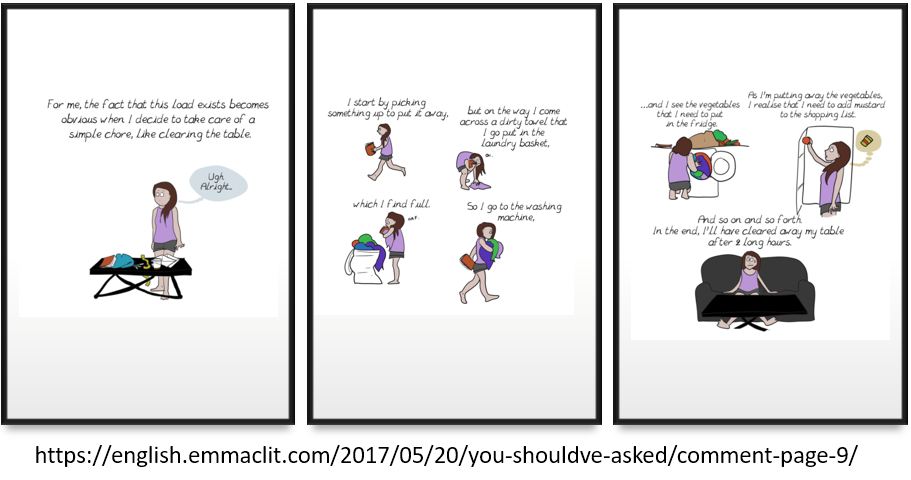
Here’s a very spot-on illustration of what the motherload looks like by Emma Clit and her amazing cartoon titled “You should have asked.”

Imagine the following scenario:

Your husband comes home on a Friday afternoon, and spur-of-the-moment declares: “Hey honey, let’s spend the day at the park tomorrow! Let’s pack up the kids and have a picnic there and spend the afternoon in nature.’

Then your hubby proceeds to get some mosquito repellent and a couple of frisbees, or a ball, packs them in a backpack, and considers it done.

Park. Tomorrow. Done.

What is happening on your end?

Let me take a guess: You spend the rest of that Friday, which, by the way, you expected to be a relaxing evening, and find yourself instead prepping snacks, packing and sorting a change of clothes for the kids, looking for the sunscreen, and some extra band-aids because one of your children has a nasty cut. And, where is that old piece of stale bread to bring along so you can feed the ducks? Because last time you didn’t come prepared and had to endure a 45-minute meltdown from the kids watching other children feed the ducks while they had nothing.

At this point, you’re already frazzled and snappy because the to-do list just got longer, and you just want the day to be done. But here you are, still preparing everything.

Meanwhile, your husband gets upset that you’re still running around like a headless chicken, saying that it’s JUST a day in the park, and asks you to sit down and relax. “Come and watch something.”

He’s gotta be kidding.

“With little ones around, it’s never ‘just going somewhere’. Why aren’t you helping?” you say in a spicy tone.

“Sure,” he says, his eyes still fixed to the screen, “tell me what to do.”

Well, that’s the problem.

How come he doesn’t realize that kids get hungry and need snacks? That they get thirsty and need water? That one child is not yet fully potty trained, and you need to plan if there’s no toilet around. And if the Littlest One needs a nap, where is that cushiony blanket to lay him on when the time comes? If it’s too hot, maybe the small, battery-operated fan can keep him cool, but it’s packed away somewhere in the basement/attic/garage along with the Christmas lights.

Oh yes, that reminds you that several of those lights don’t work, so maybe it’s time to buy new ones when December comes around.

How come no one sees how much work goes into this??

Why is trying to have fun as a mom everything but? Can motherhood even be fun? You knew it would require sacrifices, but you hoped there would be at least some moments of comic relief.

Maybe, the husband is right. Perhaps this one time, you should wing it. There’s always a convenience store nearby to buy some nasty, artificially flavored or sugar-laden snacks for the kids, so they should survive if it’s a one-off. Never mind that one of the children is Celiac or lactose intolerant.

It would be great to split things up and have hubby handle packing the clothes and the toys plus any strollers or bicycles while you just focus on snacks and drinks.

But dear hubby must likely needs a list handed over to him, and all those details are IN YOUR HEAD, so the time it takes to write it all up, you might as well have packed it yourself.

So not only do we have to think of all this and remember. It’s also us who suffer the consequences when things are forgotten or not adequately planned for.

It’s not only packing for the occasion but planning for what might go wrong because you want to save yourself problems later. (Murphy’s Law is a law for a reason) Everything is literally hanging on your shoulders.

You clearly remember, for example, the 45-minute tantrum from not having bread to feed the ducks last time you forgot something. While also having to carry a 24-lbs child for a whole kilometer around the park because she didn’t want to walk anymore, and you already had that back pain which made it all so much worse. Afterward, you even had to stop exercising altogether and instead had to pay a chiropractor to help you put it back in place. That was expensive.

Can we all collectively conclude that this is no walk in the park at all?

Our husbands fail to see all of this because things always seem to run so smoothly.

But things seem easy, breezy, lemon, squeezy because you are the one who’s been doing all of this heavy lifting and carrying the mother-effing-load!

TIME FOR A SERIOUS CONVERSATION

This is not about threats or going on strike, or trying to evenly split responsibilities and chores down the straightest line. The aim, however, should be to achieve some harmony. (It’s the reason my co-host and I decided to name our podcast that, by the way). Harmony sets the stage for creativity, flow, and enjoyment, which is what we want out of motherhood, as well as in our marriages.

If you’re constantly keeping score, you already lost.

This is not advisable.

First, starting a conversation with ‘These are aaaall the things I do, and you’re doing nothing’ will not open the gates for the honest, open dialogue that this topic needs.

Second, you want to avoid feeding the resentment monster. Keeping tabs on all the wrongdoings (or perceived wrongdoings) of our partners and stacking them up in your head will only lead to a major blowout later on that won’t help anyone.

When you do sit down for a talk, go by the suggestion of Indra Nooyi in giving people the benefit of the doubt. “Whatever anybody says or does, assume positive intent. You will be amazed at how your whole approach to a person or problem becomes very different.”

Also, keep in mind that men are incredibly straightforward. Then let us also be straightforward, defining in no uncertain terms what we need from them. If we do this in a genuine and caring fashion and have a partner who cares and is willing to cooperate, they will be willing to follow your road map.

THE ROADMAP

When tackling the mental load issue, having a game plan works best.

Yes, this also ends up on you, but the aim is to do it once and automate it.

>Make a list; check it twice. 

Start with a list of housework and parenting activities or tasks that need to be done regularly, for example, daily or weekly: cooking, laundry, bath time, grocery shopping, and the like.

Considering your schedules, likes, dislikes, and even the time of year, pick three to four activities that you are happy to pass over or have your spouse take their pick.

Hint to my type-A sisters out there: please start small. It’s better to get your partner committed to one task than having him take on six or seven, missing the whole point of the exercise and getting yourself more frazzled and frustrated than ever before.

>Make sure your partner understands the concept of OWNERSHIP

This is where an open and cooperating attitude is vital between you and your partner. The aim is that whoever gets the task or activity gets to OWN it all the way through until completion.

This is crucial. This is the detail that needs to be one hundred percent understood and agreed upon by all parties. Here is where the mental load finally gets lighter, and the mental exhaustion subsides.

Any task or chore has three parts: pre-planning, implementation, and closing the loop. It might have been that in the past, you were doing the pre-planning and closing the loop behind the scenes, and hubby only thought that implementing it was what it took.

Pre-planning and closing the loop tend to add more to the motherload than the implementation part.

So now, with the new approach, the aim is for him to OWN it all! If our partners don’t help us by owning the whole enchilada, then the motherload still stands. This is what we’re trying to lighten up for us. Closing the loop is key – I can’t stress this enough.

>A real-life example- The Green Crocodile

In my home, hubby takes care of bath time. But he didn’t OWN bath time. And this was a constant source of squabbling between us.

This is what my husband considered a completed and achieved bath time task:

  1. Take kids to the bathroom.
  2. Take off their clothes.
  3. Put kids in a bathtub. Lather and rinse.
  4. Dry them up.
  5. Put pajamas on.

Until we sat down and discussed it in-depth, he had no inkling that he was missing nine(!) steps in between and not helping with my motherload.

This is what I consider a completed and achieved bath time task:

0.1 Get towels ready and in the bathroom.

0.2 Lay out pajamas, socks, and diapers on the bed.

0.3 Get diaper cream out and on the bed.

  1. Take kids to the bathroom.
  2. Lay out green crocodile on the bathtub to avoid slips and falls.
  3. Take off their clothes.
  4. Put clothes inside the clothes hamper.
  5. Put kids in the bathtub. Lather and rinse.
  6. Dry them up.
  7. Put pajamas on.
  8. Hang green crocodile to avoid mold and mildew.
  9. Put away towels.
  10. Put away diaper cream.
  11. Bonus: take clothes to the laundry area to get them ready to be washed.

This is what closing the loop looks like to me.

Even if my husband was technically helping with bath time, I was still taking care of wet towels, dirty clothes lying on the floor (and a mere two steps away from the clothes hamper, mind you), putting away the green crocodile and diaper cream, and it ended up feeling like more work for me, not less.

Drafting the above list and understanding what are all the necessary and required steps to OWN the task completely is critical.

>Pro-tips

In the ‘going to the park’ scenario above, you will need some starter lists to start offloading the mental load to your partner. Make a list of what you planned and prepped for that specific activity (along with all possible worst-case scenarios).

Yes, it’s double work that one time, but it’s invaluable if you want to have the conversation on how hubby needs to OWN the ‘going to the park’ activity moving forward. Keeping this list handy allows him to understand what it entails when he decides to take the family to the park.

If your partner is unwilling to pre-plan, implement and close the loop on a task he has agreed to OWN, then the activity gets cancelled or re-scheduled. It’s only fair.

HAVING FUN

If you’ve been shouldering the mental load for several years, it’s a good idea to manage expectations. Let’s give our partners the benefit of the doubt and assume they have been blissfully unaware of how the sausage factory works. How they’ve missed all the boring details and planning that go into making things work without a hitch. (And not only for the special occasions or the Holidays).

But it’s never too late to start the transition. And if the children are older, you can also apply this concept with them and their assigned chores. Hence, they begin to dimension what it truly means when a task or activity falls on their plates.

For example, ’ helping with the dishes’ is too vague. Is it bringing them to the kitchen counter and leaving them there? Is it putting the dishes in the dishwasher? Is it washing, drying, AND putting the dishes away?

It’s time to reinvent what motherhood looks like, feels like, and tastes like TO YOU.

It IS possible to lighten the motherload. It IS possible to be playful as moms and have fun in our motherhood journey.

Continue to be vulnerable and open-minded with your partner. Having uncomfortable conversations about how we feel might not sound like fun. Yet, we can be pleasantly surprised by our spouses, and it might help us realize that although misguided, their support is real and that we can count on it. Our husbands and partners are not mind readers. They sometimes (most of the time) need us to Spell. It. Out.

These open conversations are what create intimacy outside of the bedroom. We not only make love behind closed doors. We make love to our partners every day in all the shared activities that sprinkle our daily lives.

As a final thought, let’s also put the Mental load into perspective. Our children and the bulk of caregiving, will evolve and change with time and will slowly diminish as our offspring become young adults. Our partners, on the other hand, are hopefully going to be with us for the rest of our lives. Let’s aim to nurture and take care of this relationship so that it evolves and grows with time.

Therefore, let’s be intentional and assertive on how we want to share the load so that it’s no longer the motherload but the love load instead.

You’ve got this, mama.

Keep your Momergy up! -Iva

Do you want the Playbook to lighten the mental load (aka the Motherload)? Join our FREE Facebook community and have access to this and many more resources!


[1] Darcy Lokman, ‘Analysis|Where do Kids Learn to Undervalue Women? From their Parents’, Washington Post, 10 Nov. 2017


[1] Darcy Lokman, ‘Analysis|Where do Kids Learn to Undervalue Women? From their Parents’, Washington Post, 10 Nov. 2017


[1] Ian Bogost, Play Anything, New York, Basic Books, 2016, p. Preface

[2] Ian Bogost, Play Anything, New York, Basic Books, 2016, p. Preface


[1] Nir Eyal, Indistractable: How to Control Your Attention and Choose Your Life, London, Bloomsbury Publishing, 2020, p. 46

[2] Nir Eyal, Indistractable: How to Control Your Attention and Choose Your Life, London, Bloomsbury Publishing, 2020, p. 45

How to Mix Boredom and Kids the Smart Way to Enjoy More Energy

Know how to swap your bundle of ‘bored’ for a bundle of joy using these powerful tips.

Nothing depletes a mom’s energy faster than a bored child. Hearing the words “I’m bored” seems to grate us down to our core, especially while glancing around and noticing all the toys and games your little one has at her disposal. You also wonder why Santa even bothers (especially knowing full well all the hassle and stress Santa went through to make Christmas magical.)

On the other hand, you have a million things to do and cannot be your child’s personal entertainer the whole day. And you shouldn’t! 

So how do we effectively deal with the whole boredom conundrum?

Loving our children means many things, but martyrdom is not one of them, and just because they’re bored, it doesn’t mean you should be the one to suffer. So let’s start off by really smashing the belief that boredom in our children is a problem.

No, it isn’t. Boredom IS good for kids!

This requires a mindset shift. But once you adopt it, guilt and stress will go out the window. 

Boredom is not a problem to be fixed

Just with this one alone, your energy levels should go back up a couple of notches. 

Let’s face it. Most times, we’re firing on all cylinders while precariously carrying around a truckload full of plates, platters, and Tupperware containers with mismatching lids that we can’t seem to put down. In other words, we’re constantly busy solving our family’s problems. It looks you’re on permanent office hours handling everyone’s affairs. Whether it’s solving for the eternal question of “What’s for dinner?” to helping your spouse find the whatchamacallit that he can’t find, to looking for a lost sock or toy.

So please don’t make boredom another problem that requires solving.

Because, when we cannot successfully “fix” the boredom, guess who shows up? That’s right. Mom guilt (another energy vampire sucking our momergy dry).

Water the plants

Metaphorically speaking. The book The Gardener and the Carpenter by Alison Gopnik is a fantastic eye-opener into how we tend to engage in constricting and stressful parenting practices. It’s really a must-read for any parent in this day and age.

Here are some quick Cliff notes: 

According to the author, the trouble with parenting is that it treats looking after children as a form of work rather than a form of love. And by treating childcare as work, parents are doomed to feel dissatisfied because it’s a relentless, thankless, messy, unpaid occupation. 

(source1)

So when you really view parenting as an act of love and ask instead, “how can I love my child better?” a whole new world of possibilities opens up.  

We fret over making the best choices for our kids all around. Therefore, there’s a lot of pressure and anxiety around everything that they do, what they eat, how they engage their time. There’s the notion that we are the ones that have to come up with all these things so that our kids turn out to be great adults and amazing human beings. 

But when you see Gopnik’s point of view, it simplifies things by making parents responsible for simply creating a set of conditions_ or fertile ground_in the gardening metaphor. But then the choices that our child makes are entirely up to them. 

For example, we can stress about planning hyper-healthy meals for the family and going crazy if you didn’t make Brussel sprouts that week because now, your kid won’t like vegetables and will now become addicted to sugar. Instead, if you just prep the foundation, make sure that what you have at home is healthy when it comes to food options, then it doesn’t matter what your child decides to eat. It’s all healthy! The choice is his, but you provide (and control) the options. This applies to all areas.  

Just by making sure that the environment is good enough for them to thrive, then, how they decide to blossom and in what the moment, it is entirely up to them. Most likely, children will thrive in a good way because parents made sure the environment was set up well. 

This book is an excellent reminder of how our children get to benefit more when we let them be and let them figure out how to play on their own, rather than being told how they need to do so. Play is their arena, their turf. If there’s anyone that knows how to play and how to do it properly, it’s children. It’s intuitive. It’s part of their DNA.

Gopnik brilliantly summarizes all this in one sentence: “We worry too much and do too much for them; children flourish when they are given freedom. When it comes to looking after kids, be a gardener, not a carpenter.”

Amen to that. 

Seriously. Get the book (and a highlighter). 

Stimulate the virtuous cycle of free play

Your child’s natural habitat is the play zone: that magical space where he gets to live out his fantasies and allows his imagination to roam free. Parents worldwide know this all too well when, after unpacking birthday gifts, children end up happily playing with the boxes, ribbons, and the foam peanuts instead of the actual toys.

That’s because children don’t need much to enjoy themselves. I’ve watched my children rip paper and create a winter wonderland with ‘snow’ while having the best time. 

And it is this unstructured time that allows children the opportunity to engage with themselves and the world – to imagine, invent, and create. 

When children are left to their own devices, they’re forced to be more creative and imaginative in finding ways to amuse themselves. So let them.

This also tends to become a virtuous cycle. Because the more that children have to engage in unstructured play, the more they use their imagination and the more creative they become. And at the same time, they start to enjoy more being left to their own devices. The more they do it, the more they have to find ways to amuse themselves, so they are forced to be more creative.

Remove the baby gate.

I get it. I’m all up for maximizing productivity every chance I’ve got. 

As adults and busy moms, we have this notion that we have to make the most out of the time we have. 

So we fall into the trap of thinking that allowing our kids to stare at their hands and draw smiley faces on their fingers is a time-waster. After all, they could be doing something better with their time: like learning a new instrument, or a new language, or something, right? We simply want to put all those extra-absorbing-and-prime-for-learning brain cells of theirs to good use.

Where I currently reside, I’m witness to this excessive structure and countless activities for young kids accounting for every single minute of their day. As in, these kids are really busy! Their school day is already long, and then, after school, they have all sorts of clubs, classes, and activities to attend.

Alison Gopnik also remarks that by keeping their timetables so packed, we’re trying to “shape (our) three-year-olds into Harvard freshmen.” There is definitely a societal pressure to want to give young children a leg up, academically speaking, so they’re able to be better prepared for the professional world.  

Yet, knowledge is not only academic; it also comes from finding new links or connections between things and making mistakes.

And free, unstructured play can provide great inventiveness and master elements of the world as they see fit. 

Boredom in this regard is fertile ground that allows children to create their own happiness and develop self-reliance while developing self-esteem, the ability to self-regulate.

Lia Karsten, a professor of Urban Geographies at the University of Amsterdam, argues that excessive extracurricular activities have transformed children from active participants to “backseat children” who are passively escorted from one structured activity to the next by their parents. 

(source 2)

I agree that having extracurricular lessons and activities is not to be avoided. They allow children to pursue things they might like and enjoy doing for a long time as a hobby or even as a profession. But the extreme IS the problem. Keeping a child in back-to-back activities the whole day until they collapse at night is not allowing their brains to be in free flow. You cannot be in free flow if everything has been structured to the tiniest detail.

The Gift of Passion

As mothers, we’re nurturers by nature. As supermom, we can come to the rescue and provide entertainment to our kids when they call out to us in despair. 

BUT when children are forced to find ways to entertain themselves, something magical happens. 

By allowing your child to connect to his own feelings, creativity, and imagination, you give them the gift of finding what they genuinely like and enjoy. A child who cannot find his own answers does not develop a true sense of self. 

There are real possible downsides to going down this route. We might end up with young adults who, in their 20s and 30s, end up having midlife crises because they don’t know what they want. 

Their parents and society always were the ones telling them what they needed to do when and how. And when they get to have the reins of their own lives and to be the ones in control, they have no clue what to do!

They haven’t tapped into their own passions or actively learned to find answers on their own. 

As adults, we know this all too well. No one can give us the answers about our own lives. We can receive guidance, mentorship, advice, examples, tricks, and hacks, but it’s up to us to decide at the end of the day.

And we usually decide based on what feels right to us_at least that’s how it should be. 

Knowing in our hearts whether we’re making the right choice or following the right path can only come when we are in tune with ourselves and our inner guidance.

This is not woo woo talk. Take a look around at all the self-help books making the NYT best-seller list that tackle this very subject. There are many adults still grappling with not knowing what they want to be or do when they grow up. And that’s okay. But allowing our kids to find and foster their unique passions and talents provides for a smoother and easier transition into adulthood, doesn’t it? 

So when you’re child says, “I’m bored,” take it as a fantastic opportunity to guide him into fine-tuning this powerful skill of learning about what he wants and what feels right. 

The Only Way Out is In

The reality is that we live in an ever-increasing digital world, with our children truly being digital natives. 

When we’re in the middle of busy and hectic times, plucking our child down with a phone or an iPad seems like a quick and easy fix to give us a much-needed breather. We tend to think that this will keep our little one’s brain engaged, but, unfortunately, it shuts down the parts that enhance creativity and imagination.

Learning how to navigate the waters of technology regarding our children is a whole subject in itself. And I am in no way opposed to technology. 

The message here is that we need to be mindful that not all technology is created equal. There’s the M&M kind of technology, and then there’s the Brussel sprout type of technology.

It’s our responsibility to be very conscious and mindful about how the technology comes into our homes and how our children make use of it. We need to assess their age and stage of development they’re in. 

Like Jonathan Fader said: “Technology is like fire. It can cook your food and can also burn down the house.”

We can’t be oblivious to the definitive downside of using technology all the time- especially when it comes to small children.

It has been well documented that apps and digital content have been scientifically devised to get non-stop engagement from us and create addiction. Even we as adults get hit with dopamine spikes throughout the day with every ping, bell, and alarm from our mobile devices.

These dopamine hits are the same as what gamblers experience in the casinos and junkies experience with drugs. 

Do we really want a constant dopamine hit to be present in our young child’s brain from so early on? 

Dr. Dimitri Christakis, director of the Center for Child Health, Behavior and Development at Seattle Children’s Research Institute, echoes this notion. He states that the cost of increased screen-time in children “will be borne by families because increased online use is associated with anxiety, depression, obesity and aggression and addiction to the medium itself.”

(source 3)

What concerns researchers is that devices are a poor substitute for activities known to be central to health, social, and physical development, including physical play and other interactions that help children learn how to confront challenging social situations.

(source 4)

Plus, both adult and young brains need downtime to allow our brains to process, file and sort the deluge of information and stimuli that we get constantly. Our brains are organs too. Just like our bodies need rest and our muscles need recovery after working out, so do our brains. 

When we don’t give our mind a chance to pause and refresh, it doesn’t work as efficiently. Likewise, our children are more likely to experience burnout and stress when constantly using devices and solely engaging with online content. 

Click here to find out how meditation can counteract the dopamine effects on young brains in as little as two minutes a day. Get started with a Meditation practice in just 7 days here.

More than one?

Siblings are allowed to bond more when they need to entertain themselves together. Yes, this possibly creates more friction and squabbles than sending them off to a class or course somewhere. 

With multiple kids, it definitely feels like our job becomes that of a referee: by constantly dispensing metaphorical yellow time-out cards left and right during the day.

But this is the perfect opportunity to fosters social competence, respect for rules, self-discipline, aggression control, problem-solving skills, leadership development, conflict resolution, and playing by the rules.

No one, and I mean, NO ONE, is more ruthless in making sure a child learns how to play by the rules and develop some good ol’ problem-solving skills than a sibling is.

Is it irritating having to step in to stop squabbles? Then don’t. Unless someone is in real danger or physically hurt, your children can learn to find a solution together if left to their own devices. 

It may sound overly simplistic to try and ignore fights and screaming. But just like boredom, the more we interfere, the less likely siblings are forced to find solutions collectively. Here is a great way to tune out and listen to some inspiring content while the drama unfolds. Click here. 

So the bottom line on children's boredom? The best way to help your child is to do nothing at all!

Children need to figure out how to use their free time or never learn how to manage it.

That being said, this is a disclaimer that every mom will find her own way to deal with boredom, and there is no right or wrong answer. You need to figure out what works for your child and you, mama.

As long as what works is coming from a place that gives you peace of mind and makes you feel like an empowered mom and NOT making you feel stressed, anxious, worried, and feeling like you’re coming up short on all ends.

This is about keeping your Momergy up. We try to make decisions that best benefit our little ones. But also, in making those decisions, we need to feel empowered as mothers. That’s the only way to continue showing up as the best version of ourselves in this motherhood journey.

So kudos to you, mom, for showing up each and every day. You’ve got this!

Hey mama! Wanting to know more about how to ride the guilt wave of parenting and continue this conversation with other fellow moms? Kick those feelings of burnout and exhaustion! Come and join our exclusive Facebook community!

We have a dedicated and in-depth Parenting through a Pandemic Series where we explore mom-related topics such as:

– Riding the guilt wave of motherhood, 

– Why connecting with our children is easier and faster than we think 

-and how to manage all this while keeping your Momergy up!

See you on the inside!

7 Yoga Lessons for Daily Life and Motherhood to Help Boost your Inner Game

Revised by Diana Kraemer, Yoga Instructor certified in Physical Education & Sport Sciences.

Spiritually doesn’t always get first dibs on our attention. If we can’t see it, we forget it’s there. It’s like that item you forgot to write down on your grocery list and that you probably forgot to buy. And then you realized it was the reason you went to the store in the first place.

Our spiritual nature tends to be very mellow and quiet when compared with our bodies and minds. We’re constantly being reminded that we have a body because we get tired, cold, and sick and crave another piece of molten lava cake. Our minds continuously churn out thoughts and emotions galore, sometimes not switching off at night when we want to sleep. 

Yet our spiritual voice tends to be quiet and speaking in soft tones, so it gets easily drowned in the noise of daily life or muffled under your child’s outbursts, the news, and the thoughts in your head.

However, our spiritual side can shine through if we allow our inner voice (or wisdom) to get louder, more clear-cut, and firmer. Most of us call it intuition or gut feeling. And the great thing about it is that it’s always present within us and is always right.

So how come we don’t nurture or learn to listen more to the ONLY voice that actually matters? 

Lack of practice for one. We probably weren’t brought up tuning in to this inner voice. Probably lack of awareness that it is always there when we need it. And maybe lack of attention as we simply tend to focus on other things. In short, there are many reasons, and we don’t need to analyze them. 

The great news is that we CAN nurture this voice to speak louder and clearer regardless of where we are in life. Once we’re attuned to our inner guide, the answers we seek will come to us from within. 

When it comes to our intuition, it’s either a very clear yes or a very clear no. There’s no in-between. We feel it in our gut so powerfully that even if something appears good on paper, ticking off all the right boxes, we can still get the sense that something is off or not right for us.

Maybe the fact that it sometimes doesn’t seem to make any sense throws us off a bit. Trusting this voice and acting accordingly takes courage and faith.

When we develop and make time for our spiritual development, we also strengthen our faith and courage in ourselves and the world around us. We relinquish the driver’s seat, so to speak, and allow trust in what is to guide us through.

In this sense, yoga is a great practice that allows us to nurture that spiritual connection in our lives. The wealth and breadth of yoga is too vast of a topic to cover here. There are many types, styles, and schools of yoga, which requires a conscious effort to find the technique, class, instructor, and even yoga mat that best fits our own needs at any given time. But once you find the right mix, yoga is a great spiritual practice to help keep you grounded and better tap into your energy and vitality.

In fact, I have found that when it comes to motherhood and life in general, yoga can offer some great insights no matter what type or style you practice. 

Here are 7 Yoga Lessons for Daily Life and Motherhood to Help Boost your Inner Game.

  1. Start off with the proper foundation. 

Nothing in life can have a long-lasting and positive outcome if it is built on shaky ground. Nature knows this better than anyone. Redwoods that can deftly grow to over 300 feet start by dedicating a long period towards growing and nourishing the roots first. 

The same holds true for us mothers. Whether it’s our day, our week, or that vital project, we need to start off by being adequately grounded. My beautiful yoga instructor likes to add “grounded and straight.” 

Before you get started with the parenting or working aspect of your day, making sure to ground yourself first should be your number one priority. 

We cannot show up for our kids, spouses, partners, loved ones, friends, or even our jobs if we’re not taking care of number one. 

It’s all about how we self-manage and self-regulate every day. To be productive and take care of every area of our lives, we need the following: recovery time, good sleep habits, nutrient-dense foods, great friendships, and a sense of belonging. 

This is how we set the foundation to show up calm, conscious, and resilient. How do you ground yourself? How do you prepare to show up fully in your life and handle all your different roles and responsibilities? The answer to these questions will set the foundation for everything else. 

  • Leave the past behind. Nothing matters but the present. 

That’s right. We sometimes fall into the trap of starting our day limping with guilt from the day before. Whatever happened, whatever we said, whatever we did or didn’t do, it’s now in the past. Long, long gone. 

Every day is a new beginning, as cliched as it sounds. A unique opportunity to start anew. Fresh. On a blank page. 

The truth is, we can’t create the present or future we want by examining or contemplating the past. Giving ourselves the grace of a brand new day or a brand new moment is critical. 

Even now, if the morning has gone horrible at home, and my kids and I have all gone on a downward spiral of craziness, I know that it can be a new reset when they get up from their naps. I CAN rescue the remainder of the day. We can always start again. And most often than not, pretty crappy mornings have had darn good afternoons when I approach it from that space of knowing that what matters is the present moment. 

  • Your breath is more important than the movement.

When we control our breath, we control the Universe. What happens outside of us is a reflection of what is happening inside. This is hands down the most straightforward and most easily forgotten truths of all. 

As mothers, we strive for speed, efficiency, doing, charging ahead, and anything else that makes us feel like we’re moving forward. But this busyness can be a trap. We can use the distractions of doing tasks and low impacting activities to avoid looking inside and making the proper adjustments. Or even making some tough decisions and choices.

Going around in circles might feel like progress, but in reality, we’re just wasting precious momergy going nowhere. Taking the time to pause and contemplate might seem weird at first if we’re used to being constantly on the go. But, in that break, in that non-doing, in that pause, that’s where we open up the space for what is needed next. 

Case in point: tantrums are huge triggers for all of us! We want to do something immediately. We want to fix them or nip them in the bud (whatever our mood happens to be). And yet, we can achieve so much more by taking some deep breaths in the middle of our children’s meltdowns. We can even find the right approach to handle them after taking a couple of deep breaths. And the same goes for almost anything else that is happening at the moment. Pause, breathe, and take stock.

  • Do whatever feels right for you TODAY.

This used to sound so odd for someone like myself, who has long suffered from type A personality. My old mantra used to be “doing whatever it takes” to get to my end goal (obviously, within a legal and moral compass). But you know what I mean. 

Listening to my body was not a priority because things needed to be done, even if they were not to my liking. 

There are two aspects to this. First, we can always decide what approach will feel right for us even with the things we MUST do and that are not of our particular liking.

I might not like having to do laundry, for example, even though I know it must be done. So what approach to this inevitable task do I choose? Maybe it feels right for me to tackle it first thing in the morning or while children are napping. No matter the context, there’s always an alternative that feels better for us, and honoring that goes hand in hand with giving ourselves some grace. 

The second part of this is that many things will simply not be challenging or burdensome when we have a clear intention and understanding of why we’re doing them. 

My eldest loves to smell his newly washed blankets and says, “How nice it smells, mommy!” with evident delight. Suppose I interpret doing the laundry as a way to show my love to him by providing clean and wonderful smelling blankets he can snuggle with at night. In that case, even if I don’t like the chore, it will feel right because my intention is that my children feel loved in every possible way.

  • Keep your Drishti when trying to balance.

The Sanskrit word Drishti is commonly translated as “point of focus.” It is a specific point to lock your eyes on while holding a yoga posture. 

When we lose focus in a yoga pose, we tend to lose our balance. Hence the importance of maintaining your Drishti

When we lose focus in our daily life, we get distracted by the unimportant and sabotage our goals and priorities. 

We have many objectives and purposes in all of our different roles. Keeping our eyes on the ball, so to speak, keeps us in our truths. If we do this, we can’t be easily distracted or confused. But if we start to look around, we get derailed. Maybe we begin to compare ourselves to others or what they’re doing, or we might start second-guessing our choices and decisions. In other words, we start diluting ourselves, and our energy gets depleted.

In my last post, I spoke about how our children can test our limits and boundaries (because that’s what they’re supposed to do). By keeping our priorities straight and knowing what the end result is supposed to look like, we won’t be easily thrown into confusion. 

  • Being upside-down helps to balance the chi in your body.

Not every day or moment in our lives will pan out the way we want it to. Put simply, we don’t like being “down” or feeling like we’re upside down. The caveat is that life itself is so dynamic that it comes with its ups and downs as part of the whole package. 

But those “downward” moments are the ones that can gift us with a better perspective and awareness of ourselves. Being comfortable with being uncomfortable is a great life skill to acquire.

From breaking out of our comfort zone to allowing ourselves to feel out of shape or bent, there’s always something new we’re discovering about the experience. And it is a great mindfulness technique to not be judgemental about it. 

It’s not so much that we’re upside down; it’s what we tell ourselves about being upside down that makes all the difference. 

Embracing the chaos, the unknown, the challenges, and the discomfort is a great place to be because we learn a great deal about ourselves in these situations. We learn to know what we’re truly capable of. 

We can’t appreciate a sunny day if we haven’t lived through some rainy ones. It’s the yin and yang aspect of life that allows us to embrace whatever shows up, knowing that, this too, shall pass.

  • Take a moment to thank yourself for the space provided.

Gratitude is such a powerful force! And we mostly tend to forget to thank ourselves too. It’s an odd habit but one that my yoga instructor emphasizes at the end of each yoga class. Taking a moment to appreciate even the most minor details helps our brains be on the lookout for more of the positive. It sends a powerful message to the world that we are choosing to focus on the positive. Finding the silver lining is a great way to strengthen our spiritual wellness because we exercise our trust, faith, and courage. Plus, gratitude is a great way to neutralize any negative emotions that might come up. When feeling low (or down), gratitude counteracts this low frequency. 

So there you have it: 7 Yoga Lessons for Daily Life and Motherhood to Help you show up better in all that you do beyond the yoga mat. Happy Spiritual Wellness Month!

Namaste.